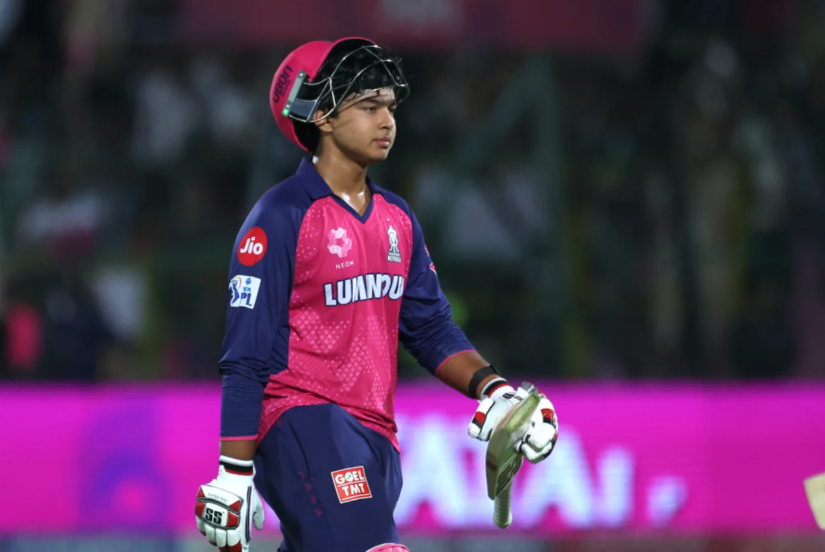
An Image of Vaibhav Sooryavanshi, Image rights belong to the BCCI.
Why do I make such a claim?
Even if you’re not a big cricket or IPL person, the news that there’s a 15-year-old kid smoking the stars likely has reached you. Here, I will break down mathematically why Vaibhav Sooryavanshi is one of the best value-for-money players in history right now and how significantly this will weaken them post-2027.
The simple premise of the claim that I am making is that because teams are held to price caps, and they’ve got an elite player for the cost of a fringe player, they have a squad worth significantly more than the cost cap, and therefore should be far better than any team built using players all paid at their true market value. Next Mega–Auction ahead of the 2028 season, they will have to pay at least 10x his current salary to retain him, which will come out of their purse for the rest of the team. Since people like Sooryavanshi don’t come along very often, it feels reasonable to claim that this is going to be the only time in the next decade or so that they have a team worth significantly more than the cost cap.
Cricket, naturally, is more complicated than this. But it’s clearly a big edge, and in the rest of this article, I will try to properly answer:
- How much would Vaibhav Sooryavanshi go for if there were an auction tomorrow?
- How significantly would the squad be impacted if they had to save that money elsewhere?
- What is the IPL landscape likely to look like post-2028?
What’s the best 15-year-old sportsman in the world worth?
I will caveat all the following statistics with the fact that I am a data person, but I am not an “In The Cricket Data Circle” person, so all data used here is limited to the numbers on espncricinfo and published auction prices. I started this analysis after Vaibhav’s 5th game of the 2026 season, so his total IPL games played are 11. In 2025, he averaged 36 runs at a strike rate of 206.55. Since his current 2026 numbers are relatively similar (40 at 263), I will average all 11 games together. This choice to combine the seasons has an impact, but it will not be major in our valuation.
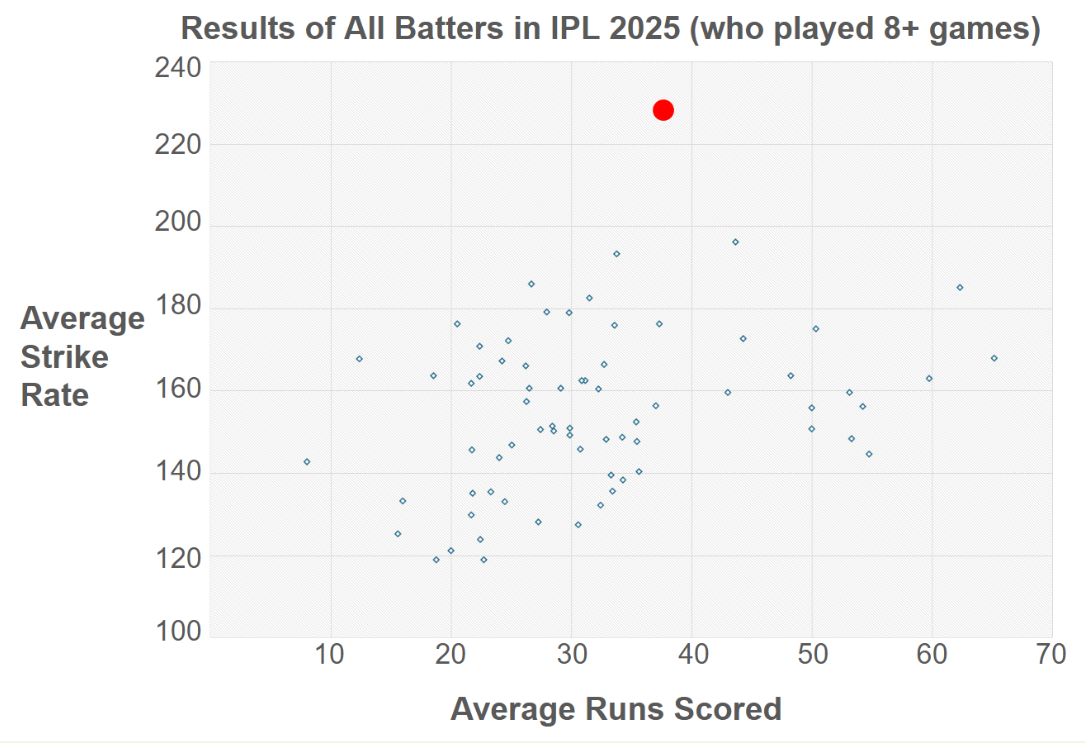
All other batters: 4 diamonds. Vaibhav Sooryavanshi across his first 11 games: Red Circle
The nearest players to Vaibhav are Nicholas Pooran (43.67 @196.25) and Abishek Sharma (33.77 @193.4). Both these players are retentions not put up for auction in 2025, costing them 21 Crore and 14 Crore respectively. If you want to factor in big brand-name stars who have commanded special value in the viewership, attention and sponsorships they will yield… look at the prices of Kohli and Tendulkar. Except those two batters also never properly faced the auction, always held by retention. Certainly, the one thing this suggests is that if he does continue to be like any of the 4 people named, he’ll be at RR for a long while.
I think his actual value matters here, though, beyond his retention cost, which works in a fixed system regardless of what you really pay. If my whole argument is that his worth is so much higher than what they pay him, we ought to know how much that really is. This will help us when considering how good they will be post 2028. It might be a bit too early to guess, but if he is really worth 30 Crore, then it costs them 18 to retain, that’d still put them in a great spot.
As demonstrated in the first graph, finding people to compare Vaibhav to is seriously difficult. I plotted the performances of every batter in the seasons before an auction, but have not included all these as they are mostly irrelevant. Our goal here is to try to find other people who were outliers like Sooryavanshi is, and what they were deemed worth, and then inflation-adjust them. Below Listed out are the high-SR (for their era) outliers.
2024 Outliers: Jake Fraser-McGurk and MS Dhoni. Dhoni naturally was a retention. 2024 was Jake Fraser-McGurk’s first IPL season. Outside the IPL he was very inconsistent and performed way worse than these numbers internationally.(14.37 @133, vs 36.66 @234 ) In the 2025 auction he went for 9 crore.
2021 Outliers - Hetmyer and Jadeja, Jadeja retained for 16 Crore, true value unknown. Hetmyer had weak 2019+20 seasons before 2021. RR paid 8.5 Crore for his services, equivalent to paying 11.3 Crore now.
2017 Outlier - Chris Lynn, 27, back after 2 years of shoulder problems and surgery, International player. Went for 9.6 crore out of a 80 crore purse, equivalent to taking 14.4 Crore out of the modern 120crore purse.
2013 Outlier – David Miller, retained for 12.5 Crore out of a 60 Crore wallet, equivalent to a 25 Crore spend today, making him the 2nd most expensive player in the league at the time
2010 Outlier - Robin Uthappa - went for 2.1mill usd, equivalent to somewhere between 20-26 crore now.
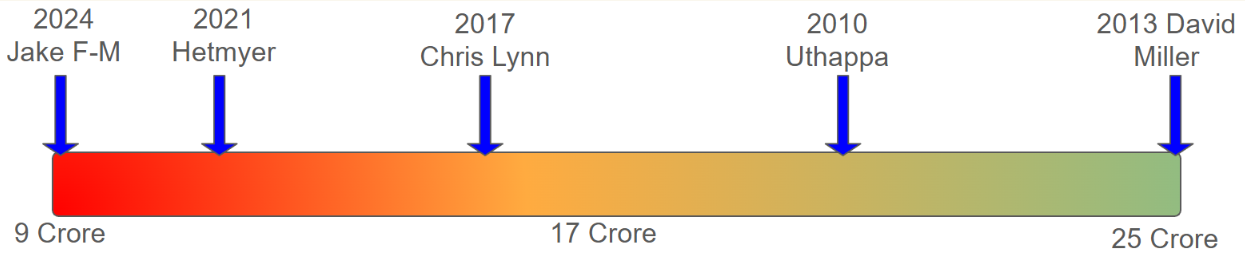
All prices plotted are adjusted to what they would be in 2025. This plot is honestly terrifying, and not what I had in mind when I started researching this, but this is what the range of auctioned high intent in-form players looks like.
The main lesson, other than the fact that if you have a world-class season and you’re Indian, you’re almost guaranteed to be a retention, is that Sooryavanshi, even amongst this group of outliers, is an outlier. The two youngest of our outlier high-intent batting freaks are Jake-Fraser McGurk (23 at the time) and David Miller… aged 24 in the 2013 season.
Even if you play it safe and assume Sooryavanshi to not be on prime David Miller levels, since he hasn’t had the multiple seasons of success yet that the 20+ crore men had; he becomes a 20 Crore man through his alluring potential to be the face of the franchise for 20 years and the increased value of domestic players, since there is no restriction on their numbers. There is also a slightly mind-melting allure that, given normal development arcs, he ought to be improving, not worsening year on year. If he becomes a consistent 250+ a season strike rate player, there may be no parallel to him. The fact that’s even a possibility drives his value up further.
I hope I have put forward a sufficient case to you here that Vaibhav Sooryavanshi should be valued between 20 and 24 Crore in the current market, (1.5-1.9Mil GBP) based on the history of outlying high-intent hitters.
How would this valuation impact squad building?
A forewarning: if you don’t really know T20 players, skip this section and jump straight to the next. Here I’ll be looking at plausible ways to save Sooryavanshi money out of the current lineup, which won’t mean much if these names aren’t familiar. If you solve this just by saying, ” Oh, get rid of Parag, or Jadeja or Hetmyer”, it doesn’t really explain how a real team would save 14-20 Crore. Under the current purse, the deduction schemes work such that Vaibhav would most likely be 18 Crore, if he continues his current form (we’ve already established he’s worth that, it’s hard to imagine his agent settling for less).
The most reasonable way to save 18 Crore would be to break it into 2-3 player reductions.
What some sample large discount downgrades look like:
-
Ravindra Jadeja (14 Crore Domestic Leftie All Rounder) – Rachin Ravindra (4 Crore Overseas Leftie All Rounder)
-
Dhruv Jurel (14 Crore Domestic WK Batter) – Devon Conway (6.25 Crore Overseas WK Batter) – There’s almost no Domestic WK Batter that went up for auction in the 1–9 Crore Range.
-
Jofra Archer (14 Crore Overseas Quick) – Anrich Nortje (6.5 Crore Overseas Quick)
-
Riyan Parag (14 Crore Domestic #5 Batter) – Nehal Wadhera (4.2 Crore #5 Batter)
-
Hetmyer (11 Crore Overseas #4 Batter) – Tim David (3 Crore Overseas #3-6 ) – Sherfaine Rutherford (2.6 Crore Overseas #5/6 Batter)
If they had to fit true-value-Vaibhav into the team now, that means combos like: “Parag for Wadhera, and Archer for Nortje”. A very crude way to assess how big these drop-offs would be to look at how these downgrade players performed last season compared to their expensive counterparts. I’m going to use run averages that remove not outs, as these can definitely make a player look much more valuable than they are, and if you didn’t get out because you were only chasing 130, it doesn’t say much.
You may know quite well on feel and vibe how big a downgrade Wadhera is on Parag, but here are the numbers:
Average: 32.75 vs 24.6, SR 166 vs 145. So you lose about 8 runs per game, struck at around 1 an over slower. Comparing Archer to Norte:
This is a bit messier since Nortje didn’t play last season due to injury. Since they have played similar career IPL games (57 vs 49) lets compare their total IPL career numbers:
Bowling Average: 26.45 vs 27.8, Economy: 7.93 vs 9.08. So Nortje is due to cost you 1.1 Runs per over more, so 4.4 per game.
This duo of swaps as a way to save Vaibhav money then, by our very approximate crude estimates, is due to cost you perhaps a total swing of 12-15 runs per game. If you started this current RR side on -15 runs per game, I think they’d still be good money to make playoffs, but the point is that changes like this do make you significantly worse.
If you are fortunate, you can, of course, cherry-pick to avoid this happening. Tim David, for 8 Crore less than Hetmyer, outscored Hettie last season. The problem is to just go absolute even and maintain the current team’s ability you really have to find at least 2, possibly 3, perfect swaps like that, where you keep all the numbers. And that’s without the power of hindsight, that I used to go select Tim David.
Another way to look at this, instead of hypothetical run-losses and imagined downgrade swaps… is real impact at the 2028 Mega Auction. Jaiswal, Parag and Durel (24, 25 and 24) are all right in, or entering, their primes for the 2028 auction. Jadeja will be 39, so that makes a nice, easy space on the retention list. Except it really doesn’t because Jaiswal, Parag, Durel and Sooryavanshi as your retentions will use up over half your budget (approx 64/120 Crore)… and they are all batters.
With 0 retained bowlers of any kind, and a heavily chopped down purse of 56 Crore to buy your remaining 21 players. This lack of flexibility will leave them exposed to being exploited and forced into overbidding to grab some bowlers. If everyone knows Rajasthan are low on funds and desperate for overseas strike bowlers, you can expect some tactical bidding to corner them. Their current bowling attack + all-rounders cost 57-60 crore. The problem is to maintain their current squad composition, they’d also have to buy 5 more batters out of that 56 crore, realistically including 2 of starter quality. Currently, 5+6 are plugged by Hetmyer and Jadeja for 25 crore, and if you had any dreams of putting 25 crore into those middle-order hitters in 2028, you’d have pennies left for bowling.
It seems impossible not to retain any of your obvious 4 retentions, and my guess is that if they all keep some decent form, they will retain them all. But in doing so, they are going to be targets in the auction, with absolutely 0 bowling in hand and down most of their purse. They could stray the way of SRH and become a team that’s great at 250 plays 250, but can’t limit the runs sufficiently on pitches that are giving something to the bowlers.
I could spend a long time coming up with creative scouting solutions as to how to efficiently build a really good team, regardless of this limitation, but the problem is that nowadays, all their rivals will be doing the same scouting. If you think you can sneak 10 Crore worth of discount on undervalued talent… but most of your opponents do the same with different undervalued talent, you’re net even, not 10 crore up.
How the finances and player availability to the IPL might change for 2028 and beyond
It is reasonable to expect that budgets will increase, which could lighten the impact of having to find those extra crores, but generally budget increases tend to lead to increases in the cost of all players now that all the teams are developed and experienced auction participants.
The IPL is considering an expansion from 74 games a season to 94, meaning 2 extra games per team. It is possible they will have to do this with an even more condensed schedule, as the rest of the cricket world seems to be broadly against letting the IPL swell and fill the calendar. Should that happen, there is a real incentive for teams to increase their bowling depth at the next mega-auction. More games mean more injuries, and usually not to batters. This means more money is needed to be put aside for bowling depth.
In terms of future talent scouting, SRH showed in their game vs Rajasthan this week that there are some really promising uncapped in the IPL domestic players. Prafal Hinge went 4/34 and yet did not have the best figures of a bowling debutant in the game. This suggests there could be a pathway to building a team worth well above the cap again. Certainly, on first viewing of Sakib Hussain, he seemed worth far more than 30 Lakh (approx 24,000 GBP).
The problem is that if we optimistically set his value to that of SRH overseas pacer Eshan Malinga, that would quadruple his value to 1.2 crore (approx. 96,000 GBP). That “discount” paid vs his true value is 5% of what we have listed for Vaibhav. 2-3 Sakib Hussain equivalents is a viable auction route, but I think it’s safe to claim you’re not going to get 10+ players like that at once. I do think, though, especially with the above schedule changes possible, this is the way for all teams to set up. If you can build your depth options on undervalued domestic stars, it can be a good start in mitigating the lack of a 20 Crore batter for almost free.
Final Verdict For Rajasthan
Considering a retention outcome where they are able to deduct 18 crores for Vaibhav, it seems like it’s still a bargain when looking at the data. If he maintains anything close to his current 2026 SR of 260, then it may well be 7-10 Crores worth of discount, but that still slashes in more than half their current competitive advantage of paying 1 Crore for a 20 crore man (or boy).
This would suggest that although they will not be able to build a team quite like this one, they ought to retain a lethal batting core and be a really solid side for the next 5-8 years. I am not signalling despair and collapse for Rajasthan post 2028, but we have shown that Vaibhav is the outlier of all outliers; they won’t be able to just find another 20 crore player for 1 crore next auction to maintain their advantage.
There almost certainly will be no team presented with an opportunity like this again for a long time, in regard to Squad Value vs Squad Cost. IPL 2026 and 2027 will be Rajasthan’s 2 best chances of victory. After that, it may be time to wave goodbye to the elite wicket-taking of Jofra Archer, or any of his most sought-after counterparts.
A mighty weight of having to live up to their equally mighty price tag every single week will fall onto the shoulders of the domestic batting quartet. I hope to see them do well. Every word I have written about RR is shared with neutrality, and a slight fondness for a team with the audacity to start a 14-year-old against LSG on April 19 2025; changing the course of Indian cricket, and likely global cricket, definitively and irreversibly.